Why Hardware-First Vendors Have Hardware-First Roadmaps
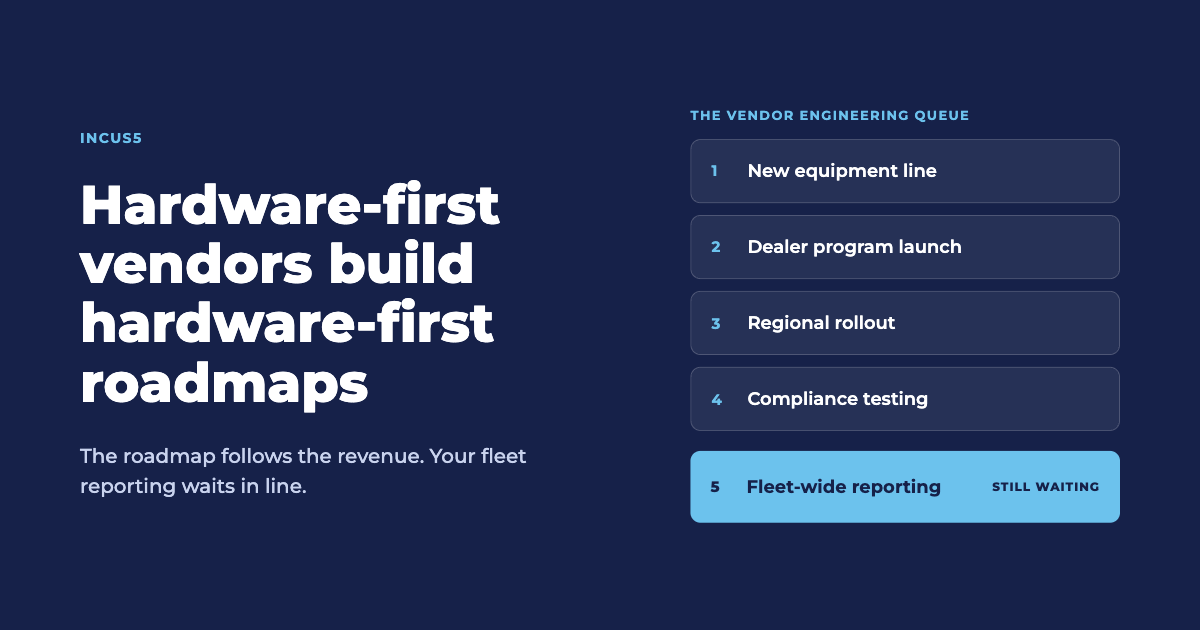
A telematics vendor announces a new equipment line. Six months later, the software gets an update supporting the new machine series. The fleet-level reporting operators asked for eighteen months ago is still on the roadmap.
This is not slow development. It is the structural result of building software to serve a hardware business.
What competes for a hardware vendor’s roadmap
A company selling telematics devices has four businesses running at once: equipment manufacturing or distribution, device installation, dealer relationships, and software. The software makes the hardware valuable, but the hardware drives the revenue.
That creates a queue. New equipment programs need device variants. Dealer networks need training and support infrastructure. Regional rollouts need localization and compliance testing. Every one of those pulls engineering resources away from software features.
When a rental operator asks for better cross-fleet utilization reporting, that request competes with a dealer program in three states and regulatory requirements in two countries. The operator’s feature is important. It is rarely the most urgent thing in the building.
The roadmap follows the revenue
A device-first vendor’s revenue model is hardware sales, installation contracts, and subscriptions tied to that hardware. Software improvements that help an operator get more value from equipment they already own do not directly grow that revenue. Features that support new device launches, easier installations, or happier dealer networks do.
This is not criticism. It recognizes what the business is built to do. A Cat dealer is well served by a portal built around Cat equipment, because the dealer’s service business, warranty programs, and parts inventory all tie back to that OEM relationship.
A rental company with JLG, Genie, Skyjack, Bobcat, and aftermarket trackers has a different problem. The portal built for one brand’s ecosystem does not extend to the whole fleet, because extending it does not serve the hardware vendor’s business model.
Why pace is not the issue
Hardware vendors are not slow at software. They are solving different problems in a different order.
An OEM’s priorities include equipment reliability, safety certifications, emissions compliance, and backward compatibility across machine generations. A new emissions standard can pull the same teams away from building software features. A product recall or dealer market launch takes precedence, because it affects the primary business.
The rental operator waiting for mixed-fleet cost-per-hour reporting is not competing with other software requests. The request is competing with the rest of the company’s obligations.
What the market has conceded
John Deere acquired Tenna in February 2026. Deere has JDLink, an OEM telematics platform covering millions of machines. It bought mixed-fleet capability anyway.
That is the public record. Deere chose to acquire rather than extend, which suggests building true mixed-fleet software inside a single-OEM business is harder than buying it from outside.
What solving this looks like
An independent platform is built to serve one job: making fleet data usable. No equipment program competes for resources, no dealer network to support, no regional device rollout to manage. The roadmap has one priority.
Device-agnostic software starts from the assumption that a fleet is mixed. Cat, Deere, JLG, Genie, Samsara, Trackunit, and attachments with nothing on them all feed the same model. The data belongs to the operator, and the platform unifies it rather than extending one brand’s view.
This does not replace an OEM portal for a dealer whose service contracts and warranty programs run through that OEM relationship. It solves a different problem for a different operator.
Incus5 reads data from 51+ telematics, OEM, and ERP systems and unifies owned and rented equipment into one source of truth. We sell no hardware. The only thing on the roadmap is what makes fleet data more useful.
When the question is whether your vendor’s software will serve your operation the way it serves their device business, the structure gives you the answer.
Key takeaways
- Hardware vendors build software roadmaps around device business priorities, equipment launches, dealer programs, and regional rollouts compete with fleet operators’ feature requests.
- The roadmap follows the revenue model: features that support hardware sales, installations, and dealer networks take precedence over software improvements for operators using equipment they already own.
- John Deere’s acquisition of Tenna in February 2026 is the public record evidence that building true mixed fleet capability inside a single OEM business is harder than buying it from outside.
- An independent, device-agnostic platform has one roadmap priority, making fleet data usable, with no equipment programs, dealer networks, or device rollouts competing for engineering resources.
Frequently asked questions
Does this mean OEM telematics platforms are not worth using?
Not at all. An OEM portal is valuable when your operation matches what it was built to serve. A Cat dealer running service contracts, warranty programs, and parts inventory through the Cat ecosystem benefits from VisionLink. A rental company with six equipment brands and aftermarket trackers has a different problem; the single-brand portal solves part of the fleet, not all of it.
Why do hardware vendors bundle software with devices instead of letting operators choose their own platform?
The software makes the hardware more valuable, and bundling it creates a complete product offering. For the vendor, it also means the customer relationship runs through their ecosystem; service, support, and data all flow back to the OEM. For operators with mixed fleets, this creates the problem: each vendor’s portal covers only the portion of the fleet carrying that brand.
Can a hardware-first vendor ever build true mixed-fleet software?
The capability exists; the question is whether the business structure supports prioritizing it. John Deere acquiring Tenna rather than extending JDLink suggests it is easier to buy mixed-fleet software than to build it inside a single-OEM company, where engineering resources are shared with equipment programs, dealer support, and compliance obligations. It is not about ability; it is about what the roadmap is built to serve.
What does device-agnostic actually mean in practice?
Device-agnostic means the platform reads data from any source the customer already has: an OEM telematics system like Cat Product Link or JDLink, aftermarket trackers like Trackunit or Samsara, ERP systems, and even assets with no telematics at all. The customer is not choosing between their existing devices and the software; the software unifies everything they already own. Flat rate per asset, regardless of data source.