Fleet
OEM Telematics Portals Don't Work for Mixed Fleets
OEM telematics portals work exactly as intended. They help a Genie dealer sell, rent and service Genie machines. They help a JLG dealer track JLG equipment. For single-brand operations, the portal does its job.
Rental companies running mixed fleets are doing a different job entirely.
What an OEM portal is built to do
The portal exists to support the manufacturer's machines. It shows you where the equipment is, how hard it is working, when it needs service, and what codes it is throwing. The data comes from the hardware the OEM installed at the factory.
For a dealer focused on one brand, that is enough. The equipment you rent is the equipment the portal covers. The contract you signed with the customer matches the machine in the system. Service is scheduled from the same screen where utilization is checked.
The problem is not the portal. The problem is assuming that what serves a single-brand dealer also serves a mixed fleet rental operation.
Why mixed fleet rental is a different job
You run Genie, JLG, Skyjack, maybe Haulotte. Each brand has its own portal. Each portal requires its own login, its own export process, its own way of naming fields. Before a Monday morning meeting, you open four browser tabs, download four spreadsheets, and paste them together in Excel.
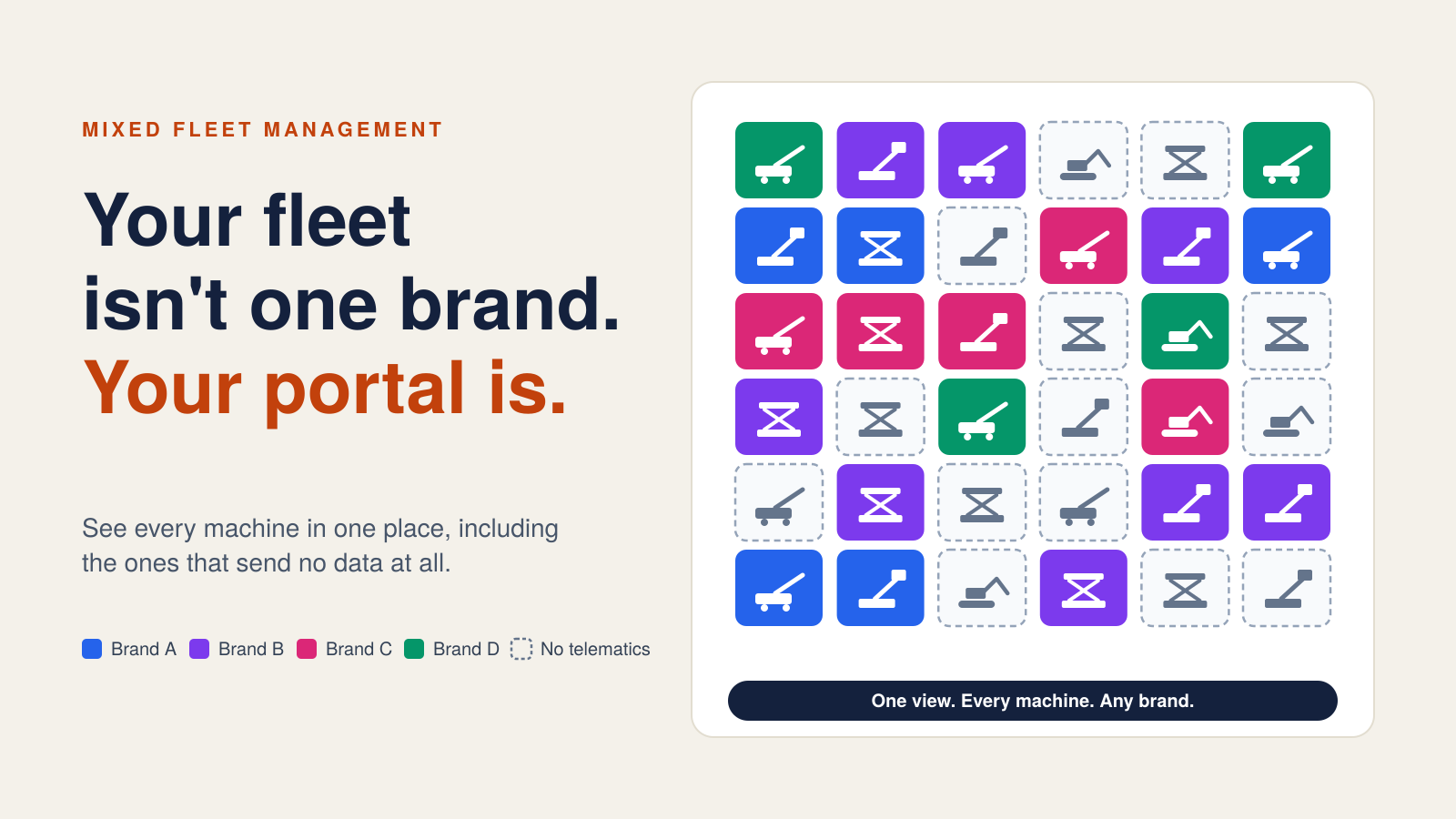
The machines with factory telematics appear. The ones with nothing on board do not. Your attachments are missing. The scissor lift you bought used three years ago is somewhere in the yard, but the previous owner's portal does not show it anymore, and you never got it added to your own account.
Now add the rental contract. The Genie portal knows the machine. Your ERP knows the customer. Neither one talks to the other. When a customer calls to dispute idle time, you open three systems to answer the question: the portal for the meter reading, the ERP for the contract, and your own notes to remember which machine went to which job.
This is not a workflow problem you can fix with discipline. It is a structural problem that comes from using tools built for a different job.
What solving this looks like
Treat telematics as an input, not as a product. Read every feed you already pay for. Connect the machines that came with factory telematics, add hardware to the ones that did not, and put them all in one system. The platform needs to be hardware agnostic, because your fleet is brand agnostic. This is the same argument behind how mixed fleet management actually works when you start from the equipment that sends you nothing.
Tie the contract to the machine. When a customer asks about idle time, the system should show the meter reading, the rental agreement, and the billing rate on one screen. The question takes ten seconds instead of three phone calls.
Make the attachments visible. A mini excavator on rent with a hydraulic breaker attached is two assets earning money. If the portal only tracks the machine and ignores what is connected to it, half your rental income is invisible to your utilization numbers.
We built Incus5 Fleet to do this. It reads OEM telematics where it exists, integrates aftermarket hardware where it does not, and connects to your ERP so the contract and the machine live in the same place. The rental operator sees the whole fleet, regardless of who manufactured each piece. It is also why we argue you should choose the software first and let the hardware follow.
One job, one system
OEM portals serve the job they were designed for. Selling and supporting a single brand is that job. Managing a mixed rental fleet, where machines come from six manufacturers and half of them report nothing, is not.
Different jobs need different tools. The portal that works for a Genie dealer does not work for a rental company running Genie, JLG, Skyjack and everything in between.
Key takeaways
- OEM portals are built to sell and support one brand's machines, and they do that job well for single-brand dealers.
- Mixed fleet rental requires seeing all equipment in one place, including machines with no factory telematics.
- Logging into multiple portals before every meeting wastes time and hides the equipment that sends no data.
- Hardware-agnostic software treats telematics as an input and ties the rental contract to the machine.
Frequently asked questions
Can I just use the OEM portal for the brands I rent most often?
You can, but you will only see part of your fleet. The machines from other manufacturers disappear, along with everything that has no factory telematics. Utilization numbers calculated from partial data are worse than useless, because they look complete when they are not. A mixed fleet needs a system that sees all of it.
Why not just standardize on one brand of equipment?
Rental customers specify brands in their contracts. A contractor asks for a Genie S-65 because that is what the job site allows, or a JLG 600S because the operator is certified on it. Saying no to the customer because your software only tracks one brand costs you the rental. The fleet has to be mixed, so the software has to handle it.
What happens to the OEM portals when I switch to hardware-agnostic software?
They stay active. The factory telematics keeps reporting to the OEM, and you keep your portal access. Hardware-agnostic software reads the same feeds the portal reads, so nothing is lost. You gain one unified view without losing the manufacturer's diagnostic tools when you need them.
How do you handle equipment with no telematics at all?
Add hardware to it. Aftermarket telematics works on anything with an engine or a battery. The platform reads both factory and aftermarket feeds, so a 2015 Skyjack with a retrofit device and a 2024 Genie with factory telematics appear in the same list. The system is agnostic about where the data comes from, because your fleet is agnostic about who built the machine.