Fleet
Mixed Fleet Management: Start With the Equipment That Sends You Nothing
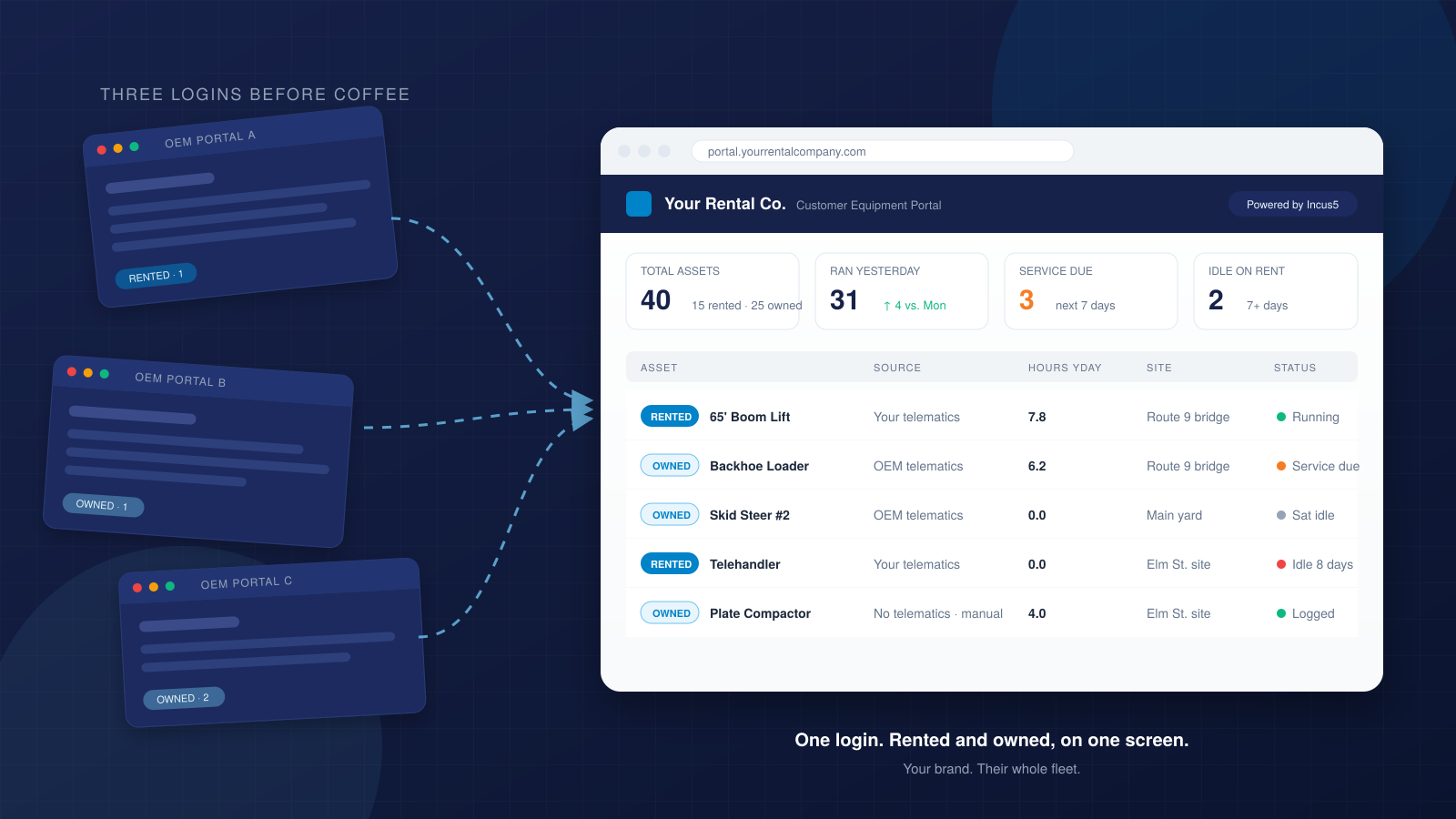
You have forty excavators with Cat Product Link. Twenty skid steers with JDLink. A dozen aerials split between JLG and Genie. And then you have the attachments.
The buckets, the hammers, the forks. The plate compactors and concrete saws. The generators that showed up on a flatbed last Tuesday from a rental house that doesn't track them. The 2012 Bobcat that still runs fine but predates anything resembling a telematics system.
None of them send you a signal. And until you account for them, you don't have mixed fleet management. You have multiple single-brand dashboards plus a spreadsheet, plus a guess.
The gap isn't between brands. It's between tracked and untracked.
The obvious version of mixed fleet management is consolidating telematics from Cat, Deere, JLG, and whoever else built a portal. That's real. Four logins before a Monday meeting is a real problem. But it's not the hardest problem.
The hardest problem is the equipment that doesn't ping. A contractor running a job site has owned machines with OEM telematics, owned machines with aftermarket trackers, owned machines with nothing, and rentals that might have any of the above or none.
The ERP knows what you own. The rental contracts know what you're renting. The telematics feeds know what's sending a signal. Nothing knows all three at once.
So the hydraulic hammer that's been on a job site in Phoenix for three weeks doesn't show up in any utilization report. The rented generator that's been idle for a month doesn't trigger an alert, because it was never in a system that could trigger one. The old Bobcat that ran 200 hours last month doesn't count toward the fleet's physical utilization, because it doesn't report hours.
Telematics covers a fraction of what you operate
| Asset type | Typical telematics status | Where the data lives instead |
|---|---|---|
| Major iron (excavators, loaders) | OEM telematics, usually active | Cat Product Link, JDLink, Komtrax |
| Aerials and telehandlers | Often tracked, multiple brands | JLG, Genie, SkyJack portals |
| Attachments | Almost never tracked | Paper records, rental contracts |
| Older owned equipment | None, or aftermarket only | ERP, service records, hour logs |
| Rented equipment | Varies by rental house | Rental contract, invoice |
Telematics gives you the machines it gives you. Real mixed-fleet management has to start from everything you operate and work backward to whatever data exists—including the data that isn't a telematics feed at all.
Rental contracts are fleet data
When a generator arrives on a job site from a rental house, you know when it arrived, when it's due back, and what you're paying. That's operational data. It belongs in the same view as the excavator hours and the aerial locations.
The same goes for fuel truck deliveries. The fuel truck driver logs what went into which machine. That record exists on paper or in a delivery system. It's not telematics. It's still data about how your fleet runs.
A mixed fleet includes assets that don't send signals. Managing it means using the data that does exist for those assets: rental contracts, fuel deliveries, service tickets, manual hour-meter reads. None of it is automated. All of it belongs in the picture.
What solving this looks like
Start from the full list of what you operate, not from the feeds you can connect. The ERP knows what you own. The rental agreements know what you're renting. Build from there.
Then connect every telematics feed you have access to. Cat, Deere, JLG, Genie, Trackunit, Samsara, whatever came with the machines or whatever you installed. Layer them onto the list.
The assets left over the ones with no feed still belong in the system. Their rental contracts, service records, fuel deliveries, manual hour reads. That data isn't as rich as a telematics feed, but it's better than pretending the asset doesn't exist.
This is what Incus5 does. We read from 51+ telematics, ERP, and operational data sources, including assets with nothing on board, and unify them into one view. Owned and rented, tracked and untracked, on the same screen.
The alternative is pretending the gaps aren't there
If you only manage what telematics can see, you're managing a fraction of your fleet and guessing at the rest. The attachments, the rentals, the old iron, they're all invisible.
Mixed fleet management isn't about making four portals look like one. It's about seeing the whole fleet, even the pieces that never send a signal.
Key takeaways
- Mixed fleet management means owned and rented, tracked and untracked, in one view, not just multiple brands consolidated
- The hardest assets to account for are attachments, older machines, and rentals with no telematics at all
- Rental contracts, fuel deliveries, and service records are fleet data, even when they're not automated
- Start from everything you operate, then layer on whatever telematics and operational data exists for each asset
Frequently asked questions
What is mixed fleet management?
Mixed fleet management is the practice of tracking and optimizing every asset you operate, own, and rent, from multiple manufacturers, with varying levels of telematics coverage in a single system. It goes beyond consolidating OEM portals to include equipment with no telematics at all, using rental contracts, service records, and other operational data.
How do you track equipment that has no telematics?
Equipment without telematics can still be tracked using existing operational data: rental contracts that show when assets arrived and when they're due back, fuel truck delivery records, manual hour-meter readings, and service tickets. This data isn't as rich as a telematics feed, but it keeps untracked assets visible alongside the rest of your fleet.
Can I see rented equipment alongside owned equipment?
Yes. A mixed fleet system pulls rental contract data alongside telematics and ERP records, so rented equipment appears in the same view as owned assets. You can see what's on each job site, whether you own it or rent it, and track rental costs alongside utilization.
What's the difference between multi-brand telematics and mixed fleet management?
Multi-brand telematics consolidation combines feeds from Cat, Deere, JLG, and other OEM portals into one view. Mixed fleet management goes further: it includes owned and rented assets, telematics and non-telematics data, and accounts for equipment that sends no signal at all. The goal is visibility into everything you operate, not just what reports to a portal.