Fleet
How to Track Equipment Without Telematics
Most of Your Small Equipment Never Sends a Signal
Attachments arrive on jobs with nothing on them. Older compaction equipment predates IoT by a decade. Generators under $5,000 do not justify a $40-a-month tracker. But those assets still move between sites, get serviced, burn fuel, and disappear when nobody is watching.
The standard advice is to put a tracker on everything. That advice comes from companies selling trackers. The operational question is not whether you can stick a device on a skid steer attachment. It is whether the $480 annual cost per attachment makes sense when you have 200 of them, and whether the resulting portal actually solves the problem you have.
The Data Exists Without the Device
A fuel truck makes a delivery to three generators on a bridge project. The driver logs the asset numbers, the gallons delivered, and the date. That record tells you three things: the equipment was on that site as of that date, it was running (fuel does not go to idle machines), and you now have fuel cost to put against the rental revenue for that job.
A rental contract carries an asset number, a start date, a return date, and often an hour meter reading at both ends. Your ERP already holds that data. It tells you the machine was in use during that window, and if the meter moved, you know utilization without a telematics feed.
A service record names the asset, the work performed, the hours on the machine, and the parts consumed. Your service management system or your filing cabinet holds that. It gives you the maintenance history and confirms the machine existed, ran, and reached the PM interval.
None of these records require a device, a subscription, or an API. They require a place to send them that recognizes operational paperwork as a data source, not a workaround.
What Tracking Without Telematics Actually Looks Like
Treating non-telematics data as legitimate input means three things structurally. First, the system has to accept records that arrive in different shapes. A telematics feed sends a position every few minutes. A fuel ticket arrives once a week. A rental contract spans weeks or months. The data layer has to accommodate all three without forcing everything into a location dot.
Second, the machine record has to carry the last known state even when nothing is transmitting. An attachment checked out to a site two weeks ago may not have sent a signal since, but the last confirmed location, the assigned operator, and the job it belongs to are all known. That is enough to answer the dispatcher’s question, which is not “where is it right now” but “where should I expect it to be, and is it available.”
Third, untracked and tracked equipment belong in the same view. Four excavators with telematics and six attachments without them are one equipment spread, not two problems. A system built only for telematics cannot show you the complete picture, because half the assets on the job never appear.
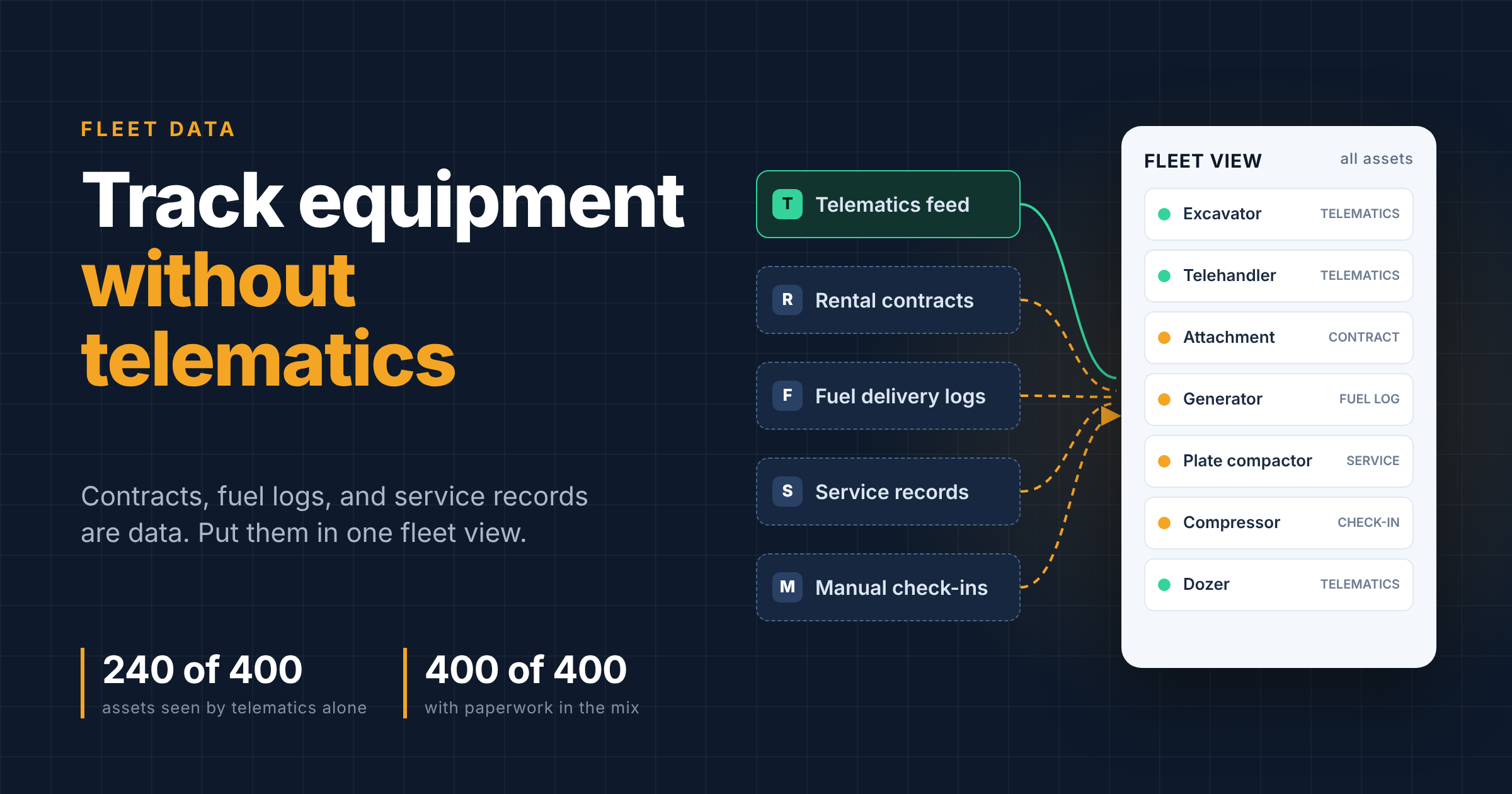
This is how mixed fleet management works at the operational level. We read telematics from the machines that have it, rental contracts and fuel records from the ones that do not, and present the entire fleet in one screen. The view starts from the whole company’s assets, then breaks them down by job, by category, or by service status.
On a 400-asset fleet where 60 percent carry telematics and 40 percent do not, a telematics-only view answers questions about 240 machines. The remaining 160 might as well not exist, even though the rental revenue, the service cost, and the redeployment decisions are identical.
Manual Check-Ins Fill the Remaining Gaps
Where no automatic record exists and no operational paperwork gets created, a manual check-in is still faster and cheaper than installing hardware. A supervisor confirms which equipment is on which site at the Monday meeting. That update goes into the system as a location record with a timestamp, and it is current enough for most decisions.
Manual check-ins are not a permanent strategy for high-value assets. They are the right answer for the long tail: the equipment that moves infrequently, costs little to replace, and does not justify a device subscription. A $1,200 towable compressor that sits on the same site for three months and then returns to the yard does not need real-time tracking. It needs a single confirmed record when it moves.
When Telematics Does Make Sense
Tracking without telematics has limits. High-value equipment that moves weekly or daily, machines prone to theft, and assets where hour-based maintenance matters (excavators, dozers, telehandlers) justify the hardware cost. Real-time location and engine hours let you catch a problem before it becomes a failure, and they let service schedule itself.
The point is not to avoid telematics. The point is to stop treating it as the only legitimate data source and to stop leaving assets out of the fleet picture because they lack a device. A complete view includes both.
Incus5 connects to 51+ telematics, ERP, and data sources, and treats fuel records, rental contracts, and service logs as equally valid inputs. You get one fleet view covering the machines that transmit and the ones that do not.
Key takeaways
- Fuel delivery records, rental contracts, and service logs are data sources that exist without telematics and can track equipment location, usage, and maintenance history.
- A complete fleet view requires a system that accepts both real-time telematics and periodic operational records in the same data model, rather than forcing everything into a location dot.
- Manual check-ins remain the most cost-effective option for low-value equipment that moves infrequently, such as attachments and small generators.
- High-value, frequently moved equipment justifies telematics hardware, but the data layer should unify tracked and untracked assets rather than treating them as separate problems.
Frequently asked questions
Can you really track equipment accurately without GPS or telematics?
You can track location and usage accurately enough for operational decisions, though not in real time. Rental contracts tell you where a machine should be and when it is due back. Fuel delivery logs confirm it was on a specific site as of a specific date. Service records show it reached a maintenance interval. These records are not continuous, but they answer the dispatcher’s actual question: where the equipment is assigned, whether it is available, and when it last moved.
What kinds of equipment are best tracked without telematics devices?
Attachments, small generators, towable compressors, older machines without factory-installed telematics, and any equipment where the annual device subscription cost exceeds 10 to 15 percent of the asset’s value. Manual check-ins and operational records work well for equipment that moves infrequently or stays on one site for weeks. High-value equipment that moves often or requires hour-based maintenance still justifies the hardware.
How do you integrate manual records with telematics data?
The integration happens at the data layer, where the system treats a fuel ticket, a rental contract, and a telematics feed as three ways of learning the same things: asset identity, location, usage, and status. A platform built for mixed fleet operations accepts records in different formats and frequencies, then normalizes them into a single asset view. The result is one screen showing your entire fleet, regardless of how the data arrived.
Is tracking without telematics accurate enough for billing or disputes?
It depends on the record type. Rental contracts with start and end hour meter readings provide billing-grade accuracy because both parties signed them. Fuel delivery logs are accurate for location and date but do not measure runtime. Manual check-ins are accurate enough for internal redeployment decisions but will not settle a dispute. Where billing accuracy matters, either telematics or a signed document is required.